Few people realize how many kinds of cats there are.
The fashionable world begins to discuss cats technically and understand their
various points of excellence.
The 'lord mayor's chain,' the 'Dutch rabbit markings,' and similar features are
understood by more cat fanciers than a few years ago; but, until within that time,
it is doubtful if the number of people who knew the difference between
the Angora and the Persian in this country amounted to a hundred.
It is but a few years since the craze for the Angora cat started.
These cats have been fashionable pets in England for some years back, and now America begins
to understand their value and the principles of breeding them.
Today, there are as handsome, well-bred animals in the United States as can be found abroad.
The demand for high-bred animals with a pedigree is greatly increasing,
and society people are beginning to understand the fine points of the thoroughbred. "
Thursday, March 09, 2006


Wednesday, March 08, 2006
New cat breed A Norwegian Forest Cat
New cat breed A Norwegian Forest Cat
Norwegian Forest Cats are solidly built, with big bodies and long, powerful legs.
Many cat fanciers say the Norwegian reminds them of the Lynx, a wild cat with a similar appearance. This breed's graceful, furry tail is as long as its body and covered in long hair that gives it a elegant appearance.
The head of this cat is triangular and its brilliant green eyes have a slight slant. Overall, the breed looks very alert, instead of having a conventional placid appearance. This cat breed comes in a wide range of colors, including white and black.
You can find the Norwegian in self, tortoiseshell, smoke, tipped, tabby, and silver tabby patterns.
While the Norwegian Forest Cat's thick, long coat looks beautiful, you should be prepared to do a bit of grooming to keep it that way.
You will have to brush this cat's coat out onces a week or your cat may end up with a matted and tangled coat that will need to be shaved off. Since clipping a cat can be quite stressful for him, try to keep his coat free of tangles.
Benjamin your cat 's friend more cats pictures here
Friday, March 03, 2006
Cat breed - Ragdoll
All information you need about cat breed click here
Information about persian cat , ragdoll, and much more
Seee you soon
benjamin
my site
Information about persian cat , ragdoll, and much more
Seee you soon
benjamin
my site
Saturday, February 18, 2006
Cat litter
Cat litter
If your cat does not use the cat litter , do not scold him for his accidents. He will just become angry and frustrated. Instead, place the cat litter in the spot where he most frequently has accidents and encourage him to use it. Once your cat uses his cat litter a few times, he should continue to use it. If he stops using the cat litter , be sure it is clean. If the litter box is not dirty, he may have a health problem, so be sure to consult your veterinarian.
More info about cat litter
If your cat does not use the cat litter , do not scold him for his accidents. He will just become angry and frustrated. Instead, place the cat litter in the spot where he most frequently has accidents and encourage him to use it. Once your cat uses his cat litter a few times, he should continue to use it. If he stops using the cat litter , be sure it is clean. If the litter box is not dirty, he may have a health problem, so be sure to consult your veterinarian.
More info about cat litter
Friday, February 17, 2006
Main coon
All info about cat breed
The Maine Coon is known as a gentle giant, which is not surprising, since these lovely cats weigh in at anywhere from nine to twenty two pounds. The breed has a squarish face, a thick neck, large ears, big, rounded eyes, and a large, muscular body. The tail is long and quite bushy.
More info about Main coon and other cat breed clic here
The Maine Coon is known as a gentle giant, which is not surprising, since these lovely cats weigh in at anywhere from nine to twenty two pounds. The breed has a squarish face, a thick neck, large ears, big, rounded eyes, and a large, muscular body. The tail is long and quite bushy.
More info about Main coon and other cat breed clic here
Friday, January 27, 2006
Cats Collars
Cats Collars information

However, cats can learn to walk on a leash. In fact, there are collar, harnesses, and leashes designed just for cats.
Cat harnesses are designed to stay securely on a cat, even when the cat is on a leash. You can buy a simple nylon harness for your cat or you can find more deluxe models that look more like padded vests. As long as the harness is completely adjustable, it should work well.
To accustom your cat to walking on a leash, you should not use the same techniques you use to train your dog. Cats do not do well with negative correction, so giving a quick tug on the leash when they do not stay at your side will not teach them to heel. Instead, praise your cat when he does what you want and ignore him when he does the wrong thing. Although you can teach your cat to tolerate a leash, don't expect him to consistently heel on command.
More info about cats collars
Tuesday, January 24, 2006
Persian cat
I'm not a Persian cat but i'm beautiful

It's me and my brothers Max and Victor. If you want more information about Persian cat
come in my site Persian cat .
Monday, January 23, 2006
The right cat breed
How to choose the right cat breed
The first thing you should consider is whether you will be able to handle having a vocal cat. Some cat breeds can actually be quite noisy.
The Scottish Fold, Somali, and the American Curl are considered to be very quiet cat breeds.
Some of the friendliest cat breeds are the Snowshoe, Abyssinian, Maine Coon, Ragdoll, Tonkinese, and the Himalayan Persian. Less sociable breeds are the Norwegian Forest Cat, the Nebelung, and the Russian Shorthair, persian cat .
Thursday, January 19, 2006
Cats Litter Boxes what you need to know
More information about cats and kittens
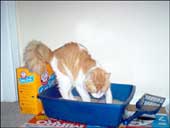
What you need to know
For most cat owners, one of the biggest drawbacks of owning a cat is the dreaded cat litter box.
Not many people like to clean litter boxes. They aren't just smelly. Litter can be quite dusty and people that change litter boxes are more vulnerable to some cat diseases that can be caught by humans than people that do not change their cats' litter boxes.
Luckily, there are several news littesr boxes designs that make the task of change cat litter much easier. One popular design is the hooded litter box.
These boxes provide privacy for more sensitive cats, but they also help keep down litter dust. The hooded box is ideal for a single cat, as long as the cat's owners can change the box frequently to keep it smelling clean and fresh. For people who don't want to handle the soiled litter, there are removable liners for these boxes. Simply lift out the whole liner filled with soiled litter and discard it. Lay down a new liner, add fresh cat litter, and replace the lid.
It is fairly easy to teach your kitten to use a litter box. The most important things for you to do are to position the litter box in the right place and to keep it extremely clean. Litter boxes should never be placed next to your cat's sleeping or eating spots, as cats do their best to keep these areas clean.
If your cat does not use the litter box, do not scold him for his accidents. He will just become angry and frustrated. Instead, place the box in the spot where he most frequently has accidents and encourage him to use it.
More information about cats and kittens free cats ebook
Wednesday, January 18, 2006
A Persian Cat

Persian cat
The Persian's most well known characteristic is probably it's face. This breed has tiny, rounded ears, very round eyes that are set far apart, and a short nose that gives the cat's face a pushed in appearance. A large, muscular body, a short neck, stocky legs, and a short, bushy tail complete the cat's distinctive look. These cats weigh in at eight to fifteen pounds.
The Persian's beautiful coat comes in Black, Chocolate, Red, Blue, Lilac, Cream, Chinchilla, Silver, and White colors. White cats can have blue, orange, or mismatched eye colors.
You can also find this breed in tortoiseshell, shaded, smoke, tipped, tabby, silver tabby, and bicolor patterns.
While most Persians are usually fairly healthy cats, there are a few serious problems that are common to this breed. These cats are often prone to kidney disease, breathing problems that are the result of their compacted faces, and reproductive problems.
In addition, blue eyed white Persians are prone to deafness. If you are looking for a cat that is content to doze on the windowsills and enjoys an occasional petting, then the gentle Persian may just be the best cat for you and your family.
More about cat breed click here
Tuesday, January 17, 2006
Cat Hairballs - What you need to do ?
More information about cats and kittens
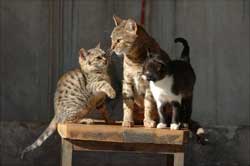
Has your cat been coughing and hacking? He may have hairballs. If you see disgusting skinny oval blobs on the floor, you will know that your cat has managed to get out one of his hairballs.What exactly is a hairball? It is a mass of hair and food that did not digest that forms inside a cat's body. Loose hair that collects on his tongue when he grooms himself. The hair comes together and forms a ball in his stomach instead of simply passing through his body. These hairballs aren't able to break down and be digested, cats often cough them up to get rid of them. While most cats don't have a difficulty with dislodging hairballs, they can occasionally pass into a cat's intestines and cause a obstruction. This can be a life threatening problem. There are a few signs you should look for to find out if your cat's hairball is dangerous. If your cat seems to be constipated, he may be experience a small blockage. If he seems lethargic and his coat is dull and unhealthy looking, or he is eating less than usual, then he may have a serious blockage. Either way, you should take him to your veterinarian to be sure a hairball is the problem and to have it removed.It is much better to prevent hairballs than to treat them after they have formed. One of the easiest ways to maintain your cat from developing a hairball is to groom him frequently, especially if he has long hair. Thoroughly examine or brush his hair each day to remove excess hair. If you begin this routine when he is a kitten, he will actually look forward to being groomed. In fact, some cats will even bring their combs to their owners so that they can be groomed. If your cat doesn't care for brushes and combs, try a grooming glove, as an alternative.If your cat still seems to form occasional hairballs, there are several dietary aids that you can try. One of these aids is dry cat food that was developed to help prevent hairballs. Don't just buy the first bag of hairball formula cat food you see. Be sure that it is high in protein and other nutrients, as well. If your cat already has a hairball, you may want to shop for a gel that can be added to his food that will help the hairball pass through his body. This gel is actually a lubricant. Talk to your veterinarian before using one of these hairball remedy for a long period of time, as they can end up removing important vitamins and minerals along with hairballs.Finally, some people have their own remedies and recipes for removing hairballs. Before using folk remedies to care for your cat, please consult with your veterinarian to be sure you aren't unintentionally causing harm to some other part of your cat's body. A few common folk remedies are butter, mineral oil, and pumpkin.
Cats and kittens, furniture, cat bed and much more
Has your cat been coughing and hacking? He may have hairballs. If you see disgusting skinny oval blobs on the floor, you will know that your cat has managed to get out one of his hairballs.What exactly is a hairball? It is a mass of hair and food that did not digest that forms inside a cat's body. Loose hair that collects on his tongue when he grooms himself. The hair comes together and forms a ball in his stomach instead of simply passing through his body. These hairballs aren't able to break down and be digested, cats often cough them up to get rid of them. While most cats don't have a difficulty with dislodging hairballs, they can occasionally pass into a cat's intestines and cause a obstruction. This can be a life threatening problem. There are a few signs you should look for to find out if your cat's hairball is dangerous. If your cat seems to be constipated, he may be experience a small blockage. If he seems lethargic and his coat is dull and unhealthy looking, or he is eating less than usual, then he may have a serious blockage. Either way, you should take him to your veterinarian to be sure a hairball is the problem and to have it removed.It is much better to prevent hairballs than to treat them after they have formed. One of the easiest ways to maintain your cat from developing a hairball is to groom him frequently, especially if he has long hair. Thoroughly examine or brush his hair each day to remove excess hair. If you begin this routine when he is a kitten, he will actually look forward to being groomed. In fact, some cats will even bring their combs to their owners so that they can be groomed. If your cat doesn't care for brushes and combs, try a grooming glove, as an alternative.If your cat still seems to form occasional hairballs, there are several dietary aids that you can try. One of these aids is dry cat food that was developed to help prevent hairballs. Don't just buy the first bag of hairball formula cat food you see. Be sure that it is high in protein and other nutrients, as well. If your cat already has a hairball, you may want to shop for a gel that can be added to his food that will help the hairball pass through his body. This gel is actually a lubricant. Talk to your veterinarian before using one of these hairball remedy for a long period of time, as they can end up removing important vitamins and minerals along with hairballs.Finally, some people have their own remedies and recipes for removing hairballs. Before using folk remedies to care for your cat, please consult with your veterinarian to be sure you aren't unintentionally causing harm to some other part of your cat's body. A few common folk remedies are butter, mineral oil, and pumpkin.
Cats and kittens, furniture, cat bed and much more
Sunday, January 15, 2006
Training a cat
More info about cats and kittens
Many people are under the mistaken impression that cats are arrogant, moody creatures that will ignore their owners' attempts to train them. They think that cats could obey and choose not to. Although cats do ignore commands because they don't feel like doing what their owners ask, sometimes they are not obeying because they simply do not understand. Training a cat generally takes a lot more time and patience than training a dog. Positive reinforcement works better than negative reinforcement with cats. If you punish them, they will just wait until you are not watching to misbehave, so it is better to simply ignore wrong responses and lavish praise on your cat when he responds correctly.You should start training your cat when he is about eight to ten weeks old. However, if you have an older cat, don't let that stop you. It may be a bit harder to teach him, but old cats can learn new tricks.
All info about cats and kittens
Many people are under the mistaken impression that cats are arrogant, moody creatures that will ignore their owners' attempts to train them. They think that cats could obey and choose not to. Although cats do ignore commands because they don't feel like doing what their owners ask, sometimes they are not obeying because they simply do not understand. Training a cat generally takes a lot more time and patience than training a dog. Positive reinforcement works better than negative reinforcement with cats. If you punish them, they will just wait until you are not watching to misbehave, so it is better to simply ignore wrong responses and lavish praise on your cat when he responds correctly.You should start training your cat when he is about eight to ten weeks old. However, if you have an older cat, don't let that stop you. It may be a bit harder to teach him, but old cats can learn new tricks.
All info about cats and kittens
Friday, January 13, 2006
Cat Growth Stages
More information about cats and kittens
When a kitten is born, it is hard to believe that one of these helpless little pink things will become a graceful and powerful hunter. However, within a year, that tiny kitten will be a mature cat. Since kittens are born blind and are completely dependent on their mothers, it is no surprise that their first stage involves little more than eating and growing. However, once your kitten's eyes open, he will begin to explore the world around him. By the time he is four weeks old, he will be romping shakily about with his siblings. He can begin to learn to use the litter box and should start to become socialized. In the wild, a kitten's mother will start to supplement his diet with dead mice or other small prey. You may prefer to give him some soft kitten food or some dry food softened in water. By the time your kitten is six to eight weeks old, he is ready to begin exploring a bit further from home. If he is indoors, he will venture into other rooms, while a feral kitten will begin to follow his mother when she goes to hang out with the rest of the local cat colony. While the kitten's mother may still bring him mice, they are no longer already dead. The kitten begins to develop his hunting abilities. Eight week old kittens are usually completely weaned and ready to go to a new home.
About cats and kittens
When a kitten is born, it is hard to believe that one of these helpless little pink things will become a graceful and powerful hunter. However, within a year, that tiny kitten will be a mature cat. Since kittens are born blind and are completely dependent on their mothers, it is no surprise that their first stage involves little more than eating and growing. However, once your kitten's eyes open, he will begin to explore the world around him. By the time he is four weeks old, he will be romping shakily about with his siblings. He can begin to learn to use the litter box and should start to become socialized. In the wild, a kitten's mother will start to supplement his diet with dead mice or other small prey. You may prefer to give him some soft kitten food or some dry food softened in water. By the time your kitten is six to eight weeks old, he is ready to begin exploring a bit further from home. If he is indoors, he will venture into other rooms, while a feral kitten will begin to follow his mother when she goes to hang out with the rest of the local cat colony. While the kitten's mother may still bring him mice, they are no longer already dead. The kitten begins to develop his hunting abilities. Eight week old kittens are usually completely weaned and ready to go to a new home.
About cats and kittens
Thursday, January 12, 2006
Cat Vaccinations

One of the most important things you can do for your cat
is to be sure its health is protected.
Cat vaccinations can protect your cat from many
common cat ailments. You should begin vaccinating your
kitten when he is six to eight weeks old. Before this time,
his mother's antibodies have been protecting him from
many of the diseases that vaccinations protect against.
However, now that he is weaned, he will need to develop
his own antibodies.
On your kitten's first veterinarian visit, your veterinarian
will give him a physical examination. He should also complete a
fecal exam to be sure your kitten doesn't have worms.
Before your veterinarian vaccinates your kitten, he should
do a blood test to be sure the kitten is not already infected
with Feline Leukemia. He may also test for Feline Infectious Peritonitis.
The tests do not take long. Your veterinarian will have preliminary
results in minutes.
If your kitten is not already infected with one of these diseases,
your veterinarian will give your kitten his first Feline Leukemia and
FIP vaccines if he is at risk for these diseases. An only cat who
never leaves his home may not need these two vaccines and your
veterinarian may recommend against giving them.
How to choose the right cat breed ?
How to Choose the Right Cat Breed ?
The first thing you should consider is whether you will be able to handle having a vocal cat. Some cat breeds can actually be quite noisy. While many cat owners do not have a problem with these vocal breeds, as they realize their cats are just communicating with them, a loud cat can be a problem in an apartment situation. Breeds that are very vocal are the Siamese Cat, the Korat, and the Burmese. The Scottish Fold, Somali, and the American Curl are considered to be very quiet cat breeds.Next, you will want to think about whether you want a cat who is cuddly or if a more aloof breed is right for you. If you do not have a lot of free time, a cuddly cat who loves attention may be the wrong choice. However, affectionate cats are usually better with children than more reserved breeds. Some of the friendliest cat breeds are the Snowshoe, Abyssinian, Maine Coon, Ragdoll, Tonkinese, and the Himalayan Persian. Less sociable breeds are the Norwegian Forest Cat, the Nebelung, and the Russian Shorthair.
More about cats and kittens
A good blog for family very cool how2guide
The first thing you should consider is whether you will be able to handle having a vocal cat. Some cat breeds can actually be quite noisy. While many cat owners do not have a problem with these vocal breeds, as they realize their cats are just communicating with them, a loud cat can be a problem in an apartment situation. Breeds that are very vocal are the Siamese Cat, the Korat, and the Burmese. The Scottish Fold, Somali, and the American Curl are considered to be very quiet cat breeds.Next, you will want to think about whether you want a cat who is cuddly or if a more aloof breed is right for you. If you do not have a lot of free time, a cuddly cat who loves attention may be the wrong choice. However, affectionate cats are usually better with children than more reserved breeds. Some of the friendliest cat breeds are the Snowshoe, Abyssinian, Maine Coon, Ragdoll, Tonkinese, and the Himalayan Persian. Less sociable breeds are the Norwegian Forest Cat, the Nebelung, and the Russian Shorthair.
More about cats and kittens
A good blog for family very cool how2guide
Wednesday, January 04, 2006
Buying a cat are your ready ?
Cats and kittens info

So,you've decided that you want to have a pet cat. However, before you shop for your kitten, you may need to consider a few important things. After all, finding out that a cat is not for you after you've already grown attached can be heart breaking. The main reason that people have to find their cats new homes is that they are allergic to cats. If you've never spent much time around cats, be sure you can spend a few hours in a home with cats without developing an allergy attack. Also, check with friends and family to be sure none of them are highly allergic.
Subscribe to:
Posts (Atom)

