
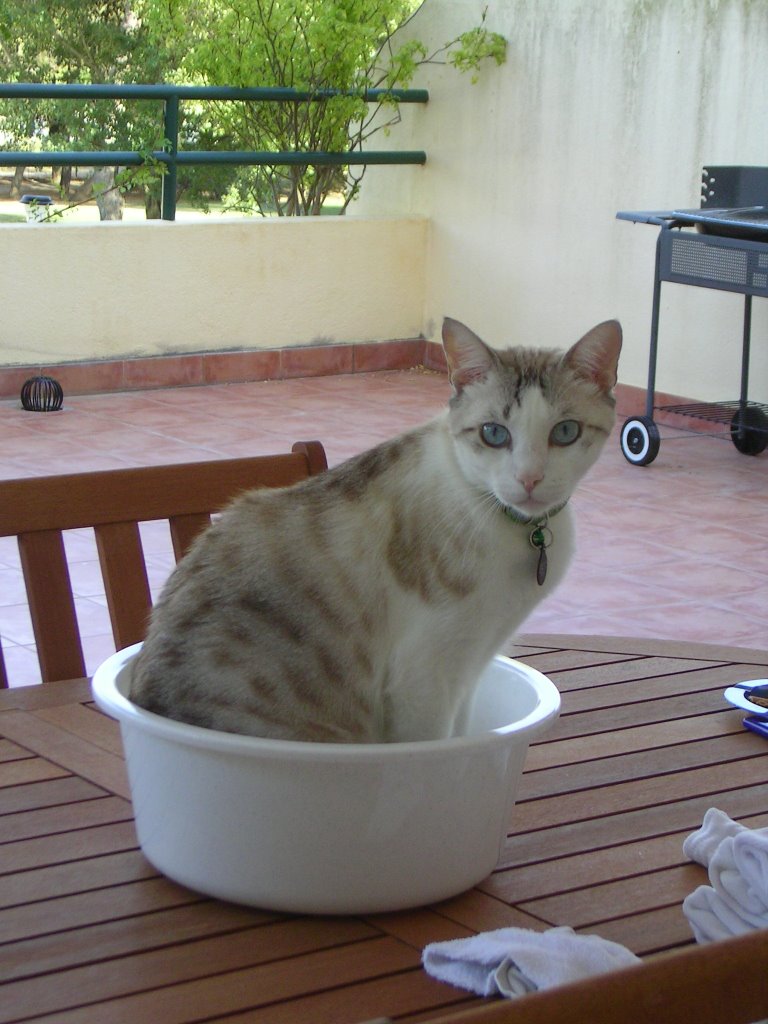
Yesterday Benjamin is dead with just 2 years.
I love my cat i'm very sad...
The phrase “fighting like cats and dogs” didn’t come up as someone’s idea of a joke just for cartoons (Tom and Jerry comes into mind). Dogs are often territorial and will fight not just new cats but other new dogs as well. They tend to mark their territory and will fight anyone who invades their space. Cats have the same tendencies and even if they are smaller than to dogs, they will scratch and fight for their territory.
Benjamin with his dog's brother Max
Most pet lovers who have both a cat and dog have a hard time making their pets coexist with each other. The usual response to this is separating the two pets and making sure they won’t meet. This is not really a practical solution to this problem as both pets tend to wander around the house and there will come a time when they will meet. This will also cause a lot of wasted time if you have to allot twice the time for playing with your pets. Another response would be to cage both pets but this method is frowned upon by most pet lovers. The best thing to do is to train both cat and dog to coexist peacefully. In this article is a series of steps to finding harmony between cats and dogs.
Perhaps the hardest thing for pet lovers to do is the introduction. Introducing a new pet requires both time and patience as both cats and dogs requires time to adjust to something new. Both cats and dogs take up to 30 days to adjust. It is even longer if you have older pet, but with proper retraining you can teach your old dogs and cat’s new tricks.
The first step is obedience. This is necessary especially for the dog which is usually the aggressor in this kind of situation. You have to train your dog to obey when you say “no”. This can be done by showing him some treat and every time he looks at it you say “no” you stop him from eating it. Do this every day and reward him every time he obeys.
While doing this with your dog, make sure the cat and dog are isolated from each other, allowing your cat to wander around the house. Cats love to roam and this will make her scent scattered in your home. After doing this, lock your cat in one room and let your dog wander around the house sniffing for the cat’s scent. This will make your dog acquainted to your cats smell and train the dog that the cat is part of the household.
Once you’ve done this for about a week, it’s time for them to see each other physically. This part requires that you have someone to help you. Have someone who can hold your cat safely and that knows how to react quickly and get your cat to safety if the dog is showing aggressiveness. Your part is to be able to restrain your dog and making sure that if he starts lunging for your cat, you’ll be there to stop him.
Dogs usually start barking whenever they see some other animals in their territory, hoping to scare them away. They won’t really lunge at something immediately. Once he starts barking, this is where the obedience part starts to come in. Say “no” and make him realize that the cat is also a pet.
If your dog starts to calm down when in the presence of the cat, then it’s the time to let him sniff the cat. Once your dog starts to decide not to bark at your cat you know that you’ve done the introduction part successfully.
The final step is making sure that both pets have the time to coexist. This part is usually the cat’s fault. Cats have the tendency to be aloof and stay away from the dog and other people. It’s not because they are afraid of the dog but more because it’s their nature to be alone. Be sure that your dog sees your cat as often as possible. You can allot some time nightly where you can do some activities with both your cat and dog.
This will allow them to play with each other and you’ll have the confidence that they won’t start fighting when they’re unsupervised.
 Cat photos "Training "
 cat photos " kitten very cute"
 and cat photos "Benjamin play"
How about some kitty baubles or doggie toys on the lower branches instead? Or, do what we did when we had both pets and little ones. We put the tree and gifts into a playpen. That may not stop Kitty, but at least the tree can't fall down as easily when she climbs it.
Another oft-forgotten item: if you have a live tree in water, wrap the base so your pets can't decide to take a drink of that watere and kewp the birds away from tae tree.aMany modern live trees have been sprayed with chemicals that may be toxic to your little friends.
Be very, very careful about candles. Your cat or bird may be enticed by the flicker of the flame, and may singe his whiskers or worse. Place glass "hurricane lanterns" or other attractive covers over candles to protect your home and your pets.
Think ahead to New Years Eve, and plan how to keep your pets from becoming frightened by the traditional firecrackers and other noisy merriment. Some dogs may be severely traumatized by fireworks, be sure to leave them inside if you go out to celebrate.
Pets, especially cats, may be stressed by the changes in household routine during the holidays, especially if you are stressed yourself. Some cats and dogs respond to stress by becoming hyper or hysterical, and some simply retreat. Plan to spend some special time with your pets to calm yourself and reassure them during this period, and if your pet is especially upset with strangers visiting, prepare a "refuge" he can go to and escape the "maddening crowd."
more information about siameses cat
How to Pet-Proof Your Holidays
The "end of the year" holidays can present some particular hazards to the health of your pet, and consequently to your peace of mind. Here are some ideas that have worked for us to make this time a happy one for all.
Make sure you check your vet's holiday hours and emergency contacts and have the information easily accessible.
Think before you decorate with plants. Cats, dogs and birds will all nibble household plants, and many, including mistletoe and some poinsettias, can make your pet very ill. Make sure your holiday greenery (and "red-ery") is out of your pet's reach.
The same is true if you have a Christmas tree. You should put only unbreakable decorations at the bottom of your tree, so there is no danger of your cat's batting a glass ball and breaking it, or the pup chewing your grandmother's antique bubble lights.
See you soon for the end ..
Cats are fastidious animals. They like things clean and apparently one thing they like clean the most is themselves. Therefore they spend an excess amount of time just grooming. The act of licking themselves helps to untangle and remove loose hair. Their tongues are specifically made for the task. They are covered with little bumps and toward the center of the tongue is tiny barb-like bumps that act to snag the hair. Unfortunately, this habit of grooming can lead to the formation of hairballs.
Cats or kitten are unable to digest the hair they swallow. However, they are able to have the hair pass through the digestive system in small amounts. A problem is caused if the cat is most likely low on fiber, which renders it incapable of passing the hair. The hair builds up and forms a hairball. The hairball can develop either in the stomach or toward the back of the throat.
The distressed cat begins to cough and attempts to throw-up the hairball. For the loving cat owner, the gagging and retching is worrisome not to mention the annoying cleanup afterwards. While the occasional hairball is probably nothing to be too alarmed about, frequent hairballs could be a cause for concern. Constant hairballs can result in digestive track troubles such as loss of appetite and constipation.
You cannot eliminate your cat from swallowing all its loose hair. However, there are actions you can take and natural remedies along with commercial products that you can use. The best way is combing or brushing your cat to prevent swallowing as much hair as possible in the first place. Longhaired cats should be combed or brushed daily and shorthairs probably only require it once or twice a week.
If your cat needs more assistance with its hairballs, there are commercial products that can be applied to the top of its front paws. The cat will attempt to lick these off; which will aid in the hair passing through the digestive system. People have used other similar lubricants such as Crisco All Vegetable Shortening, mayonnaise or butter as a substitute to these store bought products. Yet be careful, because the use of these can cause other digestive problems. Then again, some people have used Vaseline though this also should be applied only occasionally. It is recommended that you check with your veterinarian on the use, frequency and amount of any of these products before administering them to your cat.
You may also feed your cat specially made cat food diets and treats that are intended to prevent the development of hairballs. Another interesting solution is to mix in about a teaspoon of canned pumpkin to your cat's normal food. One more method used as a preventive is to feed your cat grass a couple of times a week. You can grow the grass indoors. Rye, wheat or oat grasses are the best types to use and can be purchased at pet stores or on the Internet. Do not feed your cat grass from a chemically treated lawn.
Still, it must be noted that cats will throw-up for various reasons. Some of these may be from serious underlying conditions. Therefore before attempting any of these remedies, it is advised that you consult with your veterinarian to rule out any other illness and to see which, if any of these solutions should be tried. Along with your vet's help and one or more of these suggestions, it is possible that your cat will be able to live virtually hairball free.
I use these gloves, they're very cheap and my cats are very happy.
CAT GROOMING GLOVE.


Training Your Cat To Use The Toilet
Cats and kittens are wonderful pets but cleaning the litter box can be a real drag. But what if you could train kitty to use the toilet? Instead of dealing with messy, smelly litter, you could eliminate your cats elimination with just one flush!
When training your cat to use the toilet, it's best if you have two toilets in the house. Using one just for the cat and one for yourself during the training period will make things much more convenient although you can train your cat with only 1 toilet.
For toilet training your cat you will need an aluminum tray that fits into the toilet as well as an aluminum tray as a replacement for his litter box. The idea is to get him used to the aluminum tray in the same spot his box is habitually in and then the tray in the toilet won't seem so foreign.
Keep the litter box in it's original spot but replace the box with the aluminum tray instead. Use the same litter and keep everything else the same.
Gradually move the litter box closer to the toilet. Don't move it too far each time and make sure your cat knows where it is by taking her over to it and scratching her paws in it. If your cat stops using the box, you are probably going to fast for her so slow down. Training a cat to use a litter box is a process that takes a long time so patience is key.
Once the cat is using the litter box next to the toilet, raise it an inch off the floor. make sure you use something that will keep the box stable and where the box will not slide off. Gradually, raise the box an inch higher until it is level with the toilet. As it gets higher the cat will have to jump up into it so it is critical that the box is stable, if it tips over this will scare your cat and she might not want to use it again.
At this point, you should have the tray ready in the toilet. You can use a cooking tray that is wide enough to fit the toilet. Put the tray in between that seat ring and the toilet base - make sure this holds it in place. Put some of the litter the cat is used to (make sure you use flushable litter) in the tray.
Leave the litter box level with the tray in the toilet for a couple of weeks, gradually taking away the litter in the box. Eventually, the cat should just jump up and use the tray on the toilet. Once this is happening regularly, take the litter box away.
The next step is to gradually reduce the amount of litter that is in the tray on the toilet. Also, make a little hole in the tray. Each day, reduce the litter more and make the hole a bit bigger. Do not move to fast on this or your cat might not feel comfortable using it. Eventually, you can remove the tray all together and your cat will be toilet trained!
Since your cat needs to balance on the toilet seat eventually, it is not recommended that you train cats that are too young. Wait until your cat is about 6 months old so that he is big enough to balance on the toilet seat. One important point that should be obvious is that once your cat starts using the toilet - you MUST leave the toilet lid open at all times - the cat can't open it himself!
Be patient as this training process can take several months, but when your cat is trained you will have eliminated the smell and mess of a litter box. Now the only problem you will have is remembering to knock next time you want to use the bathroom as your cat may be using the toilet!
That funny the cat on the photo is Panther, a toilet-using cat, photographed in San Francisco on 22 August 2005. He is ten years old and has been using the toilet since the age of six months. No need toilet training cat but if you want training your cat have a look at : CitiKitty Cat Toilet Training Kit
See you soon
Give me your feedback about training your cat or kitten
Sometimes when you get a new kitten, they are shy or they shy away from human touch. Sometimes they want to hide in a secluded spot away from you. This behavior is not uncommon and should be dealt with to bring the kitten's behavior to be more interactive with humans. Here are some things you can do.
1. Place kittens in a small room with areas for them to hide blocked off or absent. They should be in the room by themselves with no other pets. Start them off in a cage with enough room for them to run around a bit. Put a box in the cage to allow them to go into if they need to a little security. The cage can be partly covered with a blanket or towel to help them feel safer. Using a pheromone spray like Feliway at one spray per day will help too - just do not spray it around the litter box.
2. Do not stare at the kittens. Staring is predatory behavior and will scare the kittens. When you look at them, make sure you blink a lot and turn your head often. Practice trying to touch the kitten after he has been in the cage a couple of days. If they are not receptive to your hand right away, try using something like a back scratcher to rub their fur. Attempt to move your hand down the back scratcher to get closer to the kitten as you try this. An advanced method called the Tellington Touch can be attempted also. This method is proven to help an animal feel more comfortable around humans.
3. Start spending more and more time in the room with the kittens. A kitten needs at least two hours per day of interaction time with you. One person should do this at first, probably for the first 5-7 days you have had the kitten. Then one or more other people can be added to help the kitten get used to being around more people. Use a toy in your hand to play with the kitten and get him used to being close to your hand. Move your hand closer to the kitten when you hold the toy until you can touch him. Giving the kitten a special food treat also helps them get used to you being close to them.
4. Play a radio softly on a station with only voices for a few hours a day to help them get used to people's voices.
5. After you can touch the kitten, start letting them out of the cage. You may take the litter box out of the cage now and put the litter box and food at opposite sides of the room. Spray the Feliway around the room now. Do not spray it near the litter box. Start playing with them by using toys they like such as newspaper balls and string toys. This play time will turn into them looking forward to your return to play more with them. Do not forget to touch occasionally and pet them during play time.
6. After a time, just sit in the room with the kittens and do what you want to - like read, watch TV or use your computer. This will help them get used to people that are not there just to pay attention to them. Then after a while, start to play with them. Try to bring in other people in the room with them more often and for at least 30 minutes at a time. The other people should try to play with the kittens and also try to pet them.
All these things will help a shy kitten come out of his shell. If you have a shy kitten and do nothing the kitten may hide all the time. Help them get used to humans and human interaction. Some will need this help more than others.
More info about kittens
I suggest you this ebook : 
First, give some thought on how this new addition will get along with any pets you already have. Then assess if you are able to take the time to groom this cat properly everyday.
The next issue might be the hardest thing to decide. That is narrowing down which of the seven types of Persians you like the most. However, once that is determined, you could even settle on the color you would prefer. After that, you may have a partiality for the specific sex of your cat. A significant issue to consider is if you intend on entering your cat in show competitions or if you are just looking for a companion. A show quality Persian kitten will generally cost more.
Depending on your personality and time constraints, do you want and are you able to raise a kitten? Then you will want to locate a reputable Kitten breeder.
This is an important matter because the better the breeder, the better your chance of acquiring a strong and healthy kitten. See if the kitten appears to be well taken care of and is being raised in clean surroundings.
Has a veterinary done a complete checkup for health problems and is it up-to-date with shots? Is the breeder aware of any genetic conditions that may run in this kitten's pedigree lineage? Remember to obtain a health contract or guarantee from the breeder.
A honest breeder will have no problem supplying you with one. Additionally, you will need the vaccination certificate. If the kitten is registered or you are planning to register it, you will need these papers from the breeder too.
See you soon.
more information about adopt kitten, persian kitten and much more
Click here
The exotic and majestic appearance of the Persian kitten captures the attention of cat lovers everywhere, making it one of the most desirable breeds of cats today. Their dense and lush long-haired coat, short legs and broad head with round eyes and flat muzzle faces are distinct physical traits that make them easily identifiable to just about everyone.
According to the Cat Fanciers' Association, there are seven main categories of Persians.
1. Himalayans
2. Solid Colors
3. Silver and Golden
4. Calico and Bicolor
5. Smoke and Shaded
6. Tabby
7. Particolor
Within these categories, there are many colors and variations. The many different kinds of Persians that are available permit anyone to choose the perfect companion. However, before running out and snatching up the first Persian you see, there are several factors for purchasing a Persian you ought to consider.
If you want to know more about persian cat I suggest you this book Persian Cat
This book is a great basic overview about persian cats. It addresses a bit of the history of the breed, health tips, grooming, common characteristics of the persian, and tips for selecting a cat.
See you soon to be followed .
more information about adopt kitten, persian kitten and much more
Click here

The Angora cat, as its name indicates, comes from Angora in Western Asia, the province that is celebrated for its goats with long hair of fine quality.
In fact, the hair under the Angora cat's body often resembles the finest of the Angora goatskins. Angora cats are favorites with the Turks and Armenians, and exist in many colors, especially since they have been more carefully bred.
They vary in form, color, and disposition, and also in the quality of their hair. The standard calls for a small head, with not too long a nose, large eyes that should harmonize in color with the fur, small, pointed ears with a tuft of hair at the apex, and a very full, fluffy mane around the neck.
This mane is known as the "lord mayor's chain." The body is longer than that of the ordinary cat in proportion to its size, and is extremely graceful, and covered with long, silky hair, which is crinkly like that of the Angora goat.
This hair should be as fine as possible, and not woolly. The legs are of a moderate length, but look short on account of the length of hair on the body. Little tufts of hair growing between the toes indicate high breeding.
The Angora cat, in good condition, is one of the most beautiful and elegant creatures in the world, and few can resist its charm. The tail is long and like an ostrich plume. It is usually carried, when the cat is in good spirits, straight up, with the end waving over toward one side. The tail of the Angora serves as a barometer of its bodily and mental condition.
If the cat is ill or frightened, the tail droops, and sometimes trails on the ground; but when she is in good spirits, playing about the house or grounds, it waves like a great plume, and is exceedingly handsome. The suppleness of the Angora's tail is also a mark of fine breeding. A highbred Angora will allow its tail to be doubled or twisted without apparent notice of the performance.
See you soon Cat breed free information
New cat breed A Norwegian Forest Cat
Norwegian Forest Cats are solidly built, with big bodies and long, powerful legs.
Many cat fanciers say the Norwegian reminds them of the Lynx, a wild cat with a similar appearance. This breed's graceful, furry tail is as long as its body and covered in long hair that gives it a elegant appearance.
The head of this cat is triangular and its brilliant green eyes have a slight slant. Overall, the breed looks very alert, instead of having a conventional placid appearance. This cat breed comes in a wide range of colors, including white and black.
You can find the Norwegian in self, tortoiseshell, smoke, tipped, tabby, and silver tabby patterns.
While the Norwegian Forest Cat's thick, long coat looks beautiful, you should be prepared to do a bit of grooming to keep it that way.
You will have to brush this cat's coat out onces a week or your cat may end up with a matted and tangled coat that will need to be shaved off. Since clipping a cat can be quite stressful for him, try to keep his coat free of tangles.
Benjamin your cat 's friend more cats pictures here

However, cats can learn to walk on a leash. In fact, there are collar, harnesses, and leashes designed just for cats.
Cat harnesses are designed to stay securely on a cat, even when the cat is on a leash. You can buy a simple nylon harness for your cat or you can find more deluxe models that look more like padded vests. As long as the harness is completely adjustable, it should work well.
To accustom your cat to walking on a leash, you should not use the same techniques you use to train your dog. Cats do not do well with negative correction, so giving a quick tug on the leash when they do not stay at your side will not teach them to heel. Instead, praise your cat when he does what you want and ignore him when he does the wrong thing. Although you can teach your cat to tolerate a leash, don't expect him to consistently heel on command.
More info about cats collars

It's me and my brothers Max and Victor. If you want more information about Persian cat
come in my site Persian cat .


